Lo-Fi AI Music Video Prompts for Cozy Vibes
Lo-fi AI video prompts for the rainy window, cozy room aesthetic. Tested across the 2026 frontier video models for faceless channels and study mixes.
Kevin Gabeci
Lo-fi is a strange genre to score with video. The whole point of the music is that you don’t pay attention to it, so the video has to do the same job: be there, be pleasant, be not demanding. Most AI video work fails at this because the models are tuned to generate dramatic frames and lo-fi needs the opposite. A well-prompted lo-fi clip is a place you’d want to spend an hour, not a moment you’d want to remember.
This piece is a library of lo-fi AI video prompts for that exact use case. They are grouped by setting (rainy window, cozy desk, café, train ride, bedroom) because the setting is the entire prompt’s foundation in lo-fi. Pick a setting that fits your track’s energy and adapt the prompts inside it.
A note on what these are for. If you are running or planning a faceless YouTube channel where the audio is the product and the video exists to give viewers something to leave on, these are written for you. The full faceless channel approach is covered in the faceless YouTube AI music playbook, and the build-out steps are in how to build a faceless YouTube music channel. If you want a wider library across genres, the 100-prompt master library has the full set.
A second note on adaptation. Lo-fi is forgiving. The same prompt can produce twenty usable variations because the model has so much latitude in lighting and small object placement. Generate liberally. Keep the takes that feel quietest. Cut anything that demands attention.
Rainy window
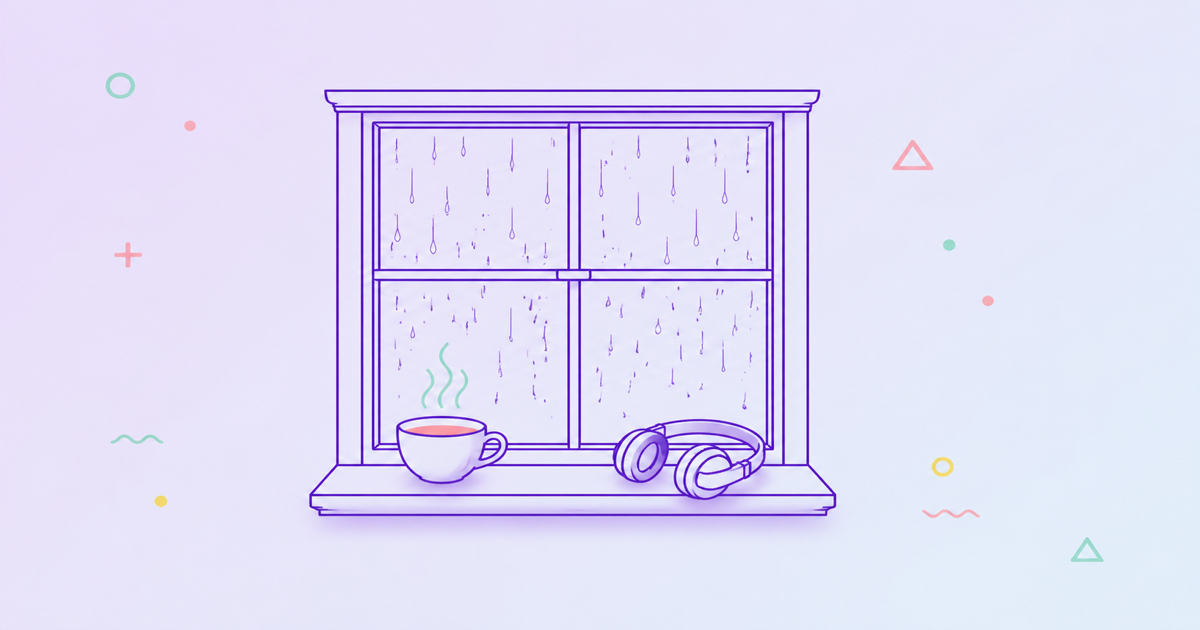
The default lo-fi setting for a reason. Reads instantly as cozy, gives you ambient motion for free.
A rainy window seen from inside a warm room, late afternoon, 35mm at f/1.8, soft warm interior lamp casting a glow, raindrops streaking and pooling on the glass, a potted plant blurred in the foreground. Camera move: locked off, 8 seconds. Mood: nowhere to be.Close up on a single raindrop's path down a window, 50mm macro, dim cool exterior light filtered through gray sky, faint reflection of a yellow lamp inside, gentle film grain. Camera move: locked off, 6 seconds. Mood: time slowing.Window of an attic apartment in autumn, rain on the glass, 35mm, one warm pendant inside the room, a coffee mug on the sill steaming faintly, blurred orange leaves outside. Camera move: locked off, 7 seconds. Mood: kept inside on purpose.Wide shot of a wall of windows on a rainy evening, café interior, 24mm, warm interior pendants reflecting in the glass, a single figure at a far table with a book, rain streaks soft. Camera move: locked off, 8 seconds. Mood: not alone but not interrupted.A circular porthole window during a soft rainstorm, brass frame, 50mm at f/2, warm cabin lamp interior, water beading on the glass, faint Kodak 500T grain. Camera move: locked off, 6 seconds. Mood: small ship, big rain.Cozy desk
The study aesthetic. Books, coffee, a single warm light, a window in the corner of frame.
A wooden desk with an open notebook, a steaming cup of coffee, and a green banker's lamp, 35mm at f/2.2, late afternoon side light from a window off frame right, faint dust in the beam. Camera move: locked off, 8 seconds. Mood: settled in for the long quiet.Top down on a desk surface, 50mm, a paperback open face down, a fountain pen, a half-eaten croissant on a plate, soft warm light from off frame left. Camera move: locked off, 6 seconds. Mood: paused mid-sentence.A vintage typewriter on a wooden desk, 35mm at f/2, single brass desk lamp, a stack of typed pages beside it, faint smoke from a candle. Camera move: very slow push in, 8 seconds. Mood: the page that is being written.A laptop screen glowing softly in a dim room, 50mm, the screen out of focus, a hand resting near a coffee mug in the warm pool of light, rain audible (visible as window streaks in background). Camera move: locked off, 7 seconds. Mood: working into the evening.A messy creative desk, 35mm, sketches and pens scattered, a small green plant catching morning window light, a half-empty matcha. Camera move: locked off, 6 seconds. Mood: in the middle of making something.Café
Soft chatter, warm bulbs, a window onto a wet street, the back of a stranger’s head.
Interior of a small café at dusk, 35mm at f/2, warm Edison bulbs over the counter, a barista's silhouette pulling an espresso, steam rising, two seated customers in soft focus. Camera move: locked off, 8 seconds. Mood: end of the working day.A corner café table, 50mm at f/1.8, a cappuccino with latte art, a notebook, the rest of the room blurred warm bokeh. Camera move: very slow push in to the cup, 6 seconds. Mood: alone but in the world.Café window from outside on a wet evening, 35mm, warm interior glow, condensation on the glass, a figure inside reading. Camera move: locked off, 7 seconds. Mood: something to look forward to.A barista's hands pouring milk into a cup, 50mm macro, single warm pendant overhead, black countertop, steam rising. Camera move: slight tilt up, 5 seconds. Mood: small craft.Wide shot, a café floor with mismatched chairs, late afternoon side light through a large front window, 24mm, two strangers at separate tables, plants on the sills. Camera move: locked off, 8 seconds. Mood: communal solitude.Train ride
Motion outside, stillness inside. The most underrated lo-fi setting in 2026.
Window seat on a train at dusk, 35mm, soft cabin light inside, blurred fields and power lines streaking past outside, the reflection of a face faint on the glass. Camera move: locked off, the world moves outside, 8 seconds. Mood: between somewhere.Interior of an empty train carriage at golden hour, 24mm, low sun cutting through the windows, dust in the beams, two empty seats, a backpack on one. Camera move: very slow dolly forward down the aisle, 7 seconds. Mood: traveling alone on purpose.Close up on a hand holding a paperback near a train window, 50mm at f/2, intermittent strobe of passing trees casting moving light over the page. Camera move: locked off, 6 seconds. Mood: chapter on a train.A coffee cup on a train tray table, 50mm macro, surface rippling slightly with the train's motion, condensation on the cup, soft cabin light. Camera move: locked off, 6 seconds. Mood: small steady thing in the moving world.Window view from a high-speed train at night, 35mm, dark cabin interior, occasional passing town lights smearing across the glass, faint grain. Camera move: locked off, 8 seconds. Mood: late ride home.Bedroom
The most personal of the lo-fi settings. Soft, warm, slightly imperfect.
A made bed with a single bedside lamp on, 35mm at f/2.2, late evening, an open book face down on the pillow, the rest of the room shadowed warm. Camera move: locked off, 7 seconds. Mood: about to be slept in.Morning light through gauze curtains onto a tangled duvet, 50mm at f/1.8, soft golden cast, a phone charging on the nightstand, a houseplant catching the light. Camera move: very slow dolly across, 6 seconds. Mood: woke up slow.A bedroom record player on a low table, 35mm, a record spinning, single warm wall sconce, vinyl sleeve leaning against the wall, dust visible in the light. Camera move: locked off, 8 seconds. Mood: side B of a Sunday.A small desk in the corner of a bedroom, 50mm, a single candle lit, headphones resting beside an open notebook, the bed soft-focus in the background. Camera move: locked off, 6 seconds. Mood: quiet personal hour.A cat curled on a duvet in afternoon window light, 50mm at f/2, soft golden side light, the cat barely breathing, a paperback open beside it. Camera move: very slow push in to the cat, 7 seconds. Mood: the room is being respected.How to adapt these
The trick with lo-fi is restraint. The temptation as a prompter is to add things. More objects on the desk, more rain, more steam, a cat. Resist. The cozy aesthetic depends on visual breathing room. Pick three or four objects per scene. Let the rest of the frame be soft warm shadow.
When you adapt these to your own track, the variables to tune are: time of day (golden hour, blue hour, late evening, soft morning), light source (single warm source, window light, candle, screen glow), and ambient motion (rain, steam, curtain breathing, dust in the beam, slight wind through leaves). Keep the camera locked or barely moving. The lo-fi viewer is not looking for a story. They are looking for somewhere to set their eyes while they study or fall asleep.
A second adaptation note. Repeat the world. If you are scoring an hour-long mix, do not generate fifty wildly different scenes. Generate eight variations of one or two settings and let them loop with crossfades. The viewer’s brain wants familiarity, not novelty. The familiarity is the comfort.
If you are ready to plug these into a project and ship a video, open Melodex, drop in a lo-fi audio track, and feed in the prompts above scene by scene. Lo-fi loops are some of the easiest videos to ship in 2026 and some of the most viewable on repeat.
Frequently asked questions
- What makes a video prompt lo-fi?
- Soft warm light, slow ambient motion (rain, steam, a fan), no human action that demands attention, muted desaturated palette, and texture (grain, dust, faint film noise). The viewer is not supposed to look at it directly.
- Can I loop these for an hour-long study mix?
- Yes. Pick one prompt, generate three or four variations, and crossfade them at the chord changes. The viewer's eye does not need a story arc, only a place to rest.
- Do these work for faceless YouTube channels?
- That is exactly the use case. They are designed to live behind a long-form audio track without distracting from it.
- What aspect ratio for these?
- 16:9 for YouTube long-form, 9:16 for Shorts loops. Lo-fi works in both, but 16:9 carries the cozy depth-of-field better.
- How do I get the slight motion without it being distracting?
- Specify the motion as ambient (rain on glass, steam from a cup, a curtain breathing) rather than as a camera move. Lock the camera off.
- Should I add film grain in post or in the prompt?
- In the prompt, every time. Naming the film stock or the grain in the prompt produces a more integrated look than slapping a grain overlay in DaVinci.
- How long should each clip be?
- Five to ten seconds, then loop. Models in 2026 still drift past ten seconds. Loop for a minute, then crossfade to the next clip.
Keep reading

How to Export Suno Stems to Ableton, Logic, FL Studio
Walkthrough for exporting up to 12 WAV stems and MIDI from Suno Studio into your DAW, with project setup and routing.

How to Make AI Music Sound Less Robotic
Ten techniques to humanize AI-generated music. Variations, layering, DAW tricks, and prompt patterns that pull the AI sheen off your track.