The AI Music Workflow: From Idea to Distribution
A full pipeline for indie musicians using AI in 2026: songwriting, production, video, distribution, and the tools that connect them.
Kevin Gabeci
The hardest part of releasing music in 2026 is not making it. The tools have collapsed the technical ceiling so far that an afternoon is enough to go from “I have a song idea” to “I have a finished track.” The hard part is the rest of the pipeline. Video. Distribution. Promotion. The connective tissue that turns a finished file into a release that anyone hears.
I have shipped a handful of tracks through this exact workflow and watched friends ship more. What follows is the full pipeline as it actually works in 2026, the tools that link the stages, and the parts where humans still matter more than software.
The full pipeline overview
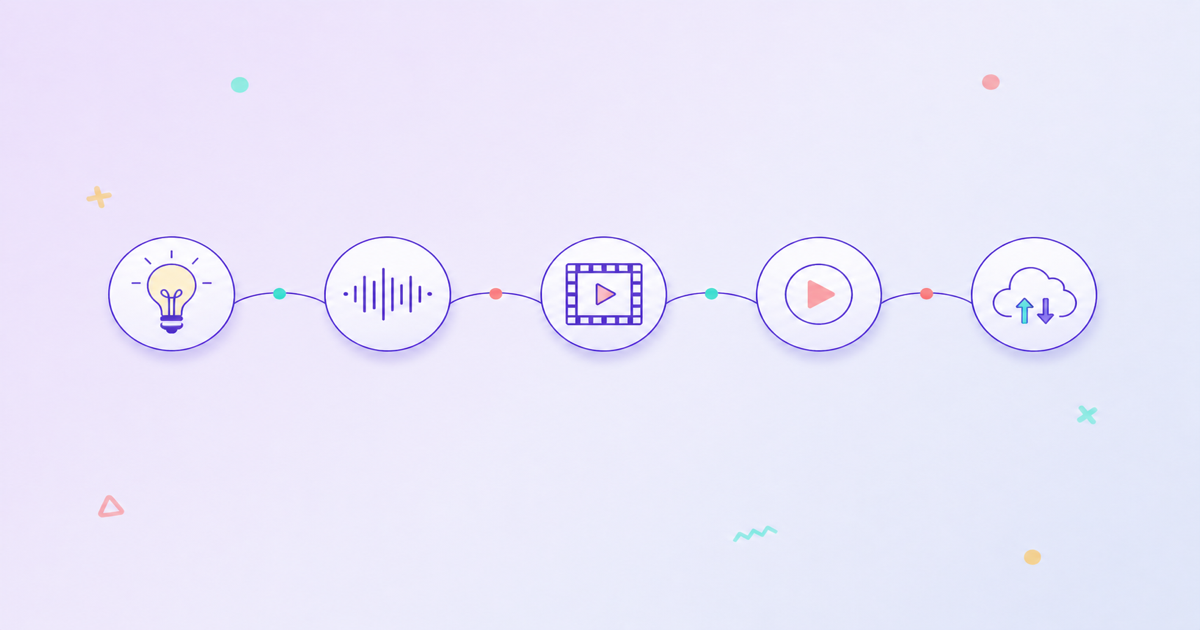
There are five stages, in order:
- Idea and lyrics. You decide what the song is about and write the words.
- Audio production. You generate or record the audio, including vocals and instrumentation.
- Video. You produce a music video, a vertical short, or both.
- Distribution. You get the track onto Spotify, Apple Music, YouTube Music, and the long tail.
- Promotion. You make sure someone presses play.
Each stage has two or three viable tools at indie budgets. None of the tools talk to each other natively. The connective work, exporting from stage one to feed into stage two, naming files so they survive stage three, is yours. That is where most beginners lose hours, and where a written checklist saves you.
A useful rule of thumb. Spend roughly equal time on stages two, three, and five. Stage one is fast (a few hours). Stage four is fast (about thirty minutes once you have done it once). The middle stages, where the actual creative output lives, deserve real attention. Promotion deserves more than most musicians give it. If you spent three days on the song and one hour on the launch, you are doing it backwards.
Stage 1: idea and lyrics
This is the cheapest stage and the one most people skip. The mistake is treating “the song idea” as a vibe. A vibe is not enough to feed downstream tools. You need a concrete subject, a concrete emotional turn, and a concrete world the song lives in.
I write all of that in a single Notion page before I touch any generator. Title, working title at least. One sentence describing what the song is about. Verse, chorus, verse, chorus, bridge, final chorus drafted in plain text. Then a short note for each section about the energy I want underneath it.
For lyrics, I write them myself. The generators can do it but the output is generic in ways that show up in the final track. Even one rewrite pass on a model’s lyric output produces something noticeably more specific. If you really do not want to write, treat the AI’s first lyric pass as raw material and edit aggressively.
Two practical habits help. Read the lyrics out loud before you commit. AI vocals punish lines that sound clever but feel mechanical. And cut anything that does not paint a picture. The visual stage downstream will thank you.
For the deeper version of the lyrics-first creative process, the three workflows post breaks down when to start from lyrics versus melody versus visuals.
Stage 2: audio production
This is where the AI tools earn their keep. Two main camps in 2026:
Prompt-to-song generators. Suno and Udio are the names everyone knows. You feed them lyrics and a style brief, you get back a full mix with vocals and instrumentation. Free tiers exist, paid tiers run roughly $8 to $30 a month depending on how much output you need. Quality is genuinely studio-adjacent at this point, especially if you iterate. The detailed Suno vs Udio comparison covers which one fits which kind of song.
Voice and vocal tools. ElevenLabs and Resemble cover synthetic vocals if you want to clone your own voice or use a licensed model. Useful if the prompt-to-song output is close but the vocal does not feel like yours.
The pattern that works. Generate three or four full takes of the song with slight variations in the style prompt. Pick the best one as the spine. If the vocal is great but the instrumentation is wrong, regenerate the instrumental layer separately. If the instrumental is right but the vocal misses, swap the vocal in a voice tool. You are layering, not waiting for one perfect generation.
Mastering is the last sub-step. Free tools like LANDR’s free tier or BandLab Mastering will get you to streaming-loudness standards. Paid tools like iZotope Ozone are overkill at this stage but worth it once you have ten releases under your belt and your ear has caught up.
Stage 3: video
Every release in 2026 needs at least one video. Two if you want algorithmic coverage. The horizontal one for YouTube, the vertical one for TikTok, Reels, and Shorts.
Three reasonable options:
- AI video generators. Runway, Kling, Sora 2 if you have access. Best for cinematic, scene-by-scene videos.
- Lyric video generators. Tools that auto-sync lyrics to a background. Faster, less interesting, fine for catalog tracks that just need a YouTube presence.
- Integrated music video platforms. Melodex falls here. The audio and the video live in the same project, the platform handles sync, and you get out two aspect ratios from one workflow.
The full breakdown of which video flow to use lives in the complete guide to AI music video. The short version: if you only have time for one video, make it vertical. The horizontal version can be a static image with audio for a quiet release. The vertical version is what carries on social.
The real work in this stage is sync. Cuts on the beat. Visual energy that matches musical energy. A video where the visuals drift while the music goes hard reads as low effort to viewers, even if every individual shot is gorgeous. Spend the iteration time on tightening sync, not on chasing one more shot.
Stage 4: distribution
You upload your finished track once, and it propagates to every streaming platform in the world. The mechanics are boring and that is good news.
The two distributors I have used. DistroKid runs roughly $23 a year for unlimited releases. Tunecore runs higher per release but offers more features for active artists. CDBaby still exists and is fine. Amuse has a free tier with a slower payout. Pick one, do not overthink it.
What you upload:
- The mastered audio, WAV or FLAC at 16-bit or 24-bit.
- Cover art, square, at least 3000 by 3000 pixels.
- Metadata, artist name, track title, genre, language, ISRC code (the distributor generates this).
- Release date, set at least a week out so playlist editors can hear it.
For the AI-specific gotchas, see the Spotify and Apple distribution guide. Short version: do not lie about the human contribution, do not use cloned voices of real people, fill out the metadata properly. Both platforms are tolerant of AI music. They are intolerant of fraud.
YouTube is technically separate. The distributor uploads to YouTube Music for you, but the actual YouTube video, the one with views and a thumbnail, you upload yourself through YouTube Studio. Treat it as its own channel.
Stage 5: promotion
This is the stage that decides whether you have a release or a file in a folder. The tools cannot save you here. The taste, the relationships, and the sustained effort matter more than any platform.
What works in 2026:
- Vertical short clips. Three or four 15-to-30 second clips of the track, each with different visuals, posted across TikTok, Reels, and Shorts on a staggered schedule. One of them might catch.
- Pre-save campaigns. Smart links from services like Linkfire or Hypeddit that push fans to pre-save the track on Spotify before launch. Pre-saves boost first-day algorithmic placement.
- Genre-specific subreddits and Discords. Lo-fi has its communities, synthwave has its communities, ambient has its communities. Find three, post once a week, do not spam.
- Email list. If you have one, this is the highest-conversion promotion channel by a wide margin. If you do not, start one with the next release.
What does not work as well as people claim. Buying playlist placements (most of them are bots), running cold ads to a track without an established audience (you burn money), and posting “out now” on Twitter once and hoping (the algorithm has moved on by Tuesday).
The honest math. Most indie tracks land somewhere between 100 and 5000 streams in their first month. Outliers exist. The path to outliers is having released 10, 20, 50 tracks before, not getting lucky on track number one.
Where humans still matter
The five-stage pipeline makes it sound automated. It is not. Humans still beat AI on five things.
Taste. Knowing which take is the good one. Models can generate, they cannot judge. Your ear does the judging.
Lyrics with weight. A line that genuinely lands on a listener almost always came from a person who lived something. Models can imitate the form, not the source.
Visual direction. The world the video lives in, the through-line that ties scenes together, the emotional arc. Generators handle pixels. Direction is yours.
Promotion as relationship. People share tracks because of who made them, not because the algorithm dictated it. Showing up, being human in public, replying to comments. None of that is automated.
Sustained output. The artists who break through in this medium are the ones releasing every two or three weeks, learning from each one. That cadence is a human discipline. The tools enable it but do not enforce it.
What I have shipped this way
A practical reality check. I have used a version of this pipeline to ship a handful of singles in 2026, ranging from a moody synthwave track that found a small but loyal audience on TikTok, to a lo-fi instrumental that quietly accrues streams from Spotify’s algorithmic playlists, to a cinematic ambient piece that I made primarily as a video showcase and that lives on YouTube.
The most useful lesson from all of them. The track that did best was not the one I spent most time on. It was the one with the clearest single emotional idea, the cleanest 15-second clip for vertical video, and the release I happened to be talking about in three different communities the week it dropped. Quality matters. Distribution and promotion matter just as much. The pipeline only works if you respect every stage.
For the full stack of AI tools that feed this workflow, the indie musician AI toolkit has the breakdown by stage with prices.
A realistic timeline for a single release
If you are running this pipeline for the first time, plan roughly three weeks from concept to public release. The breakdown looks like this.
Days one and two. Lyric draft, world description, and a working title. Maybe a rough demo melody hummed into a phone if that is your starting point. No tools beyond a notes app at this stage.
Days three through seven. Audio generation. This is the iteration-heavy stage. You will generate twenty or thirty takes across the song, narrowing toward the version you actually want. Do not commit early. The third generation often beats the first by a wide margin and the tenth occasionally beats the third.
Days eight through ten. Mastering and final mix tweaks. Quick if you are using a streaming-loudness AI master, slower if you are doing manual touch-up.
Days eleven through fifteen. Video. Generate scenes, render, review, regenerate. Plan for at least one full day of waiting on render queues. Plan for one full day of cutting and sequencing. Vertical and horizontal versions in parallel where the tool supports it.
Days sixteen through eighteen. Distribution upload. Cover art finalized. Metadata filled out, ISRC code generated, release date scheduled at least seven days out so playlist editors can preview.
Days nineteen through twenty-one. Pre-release promotion. Pre-save link circulated, vertical clips queued in TikTok, Reels, and Shorts. Subreddit and Discord posts drafted but not yet published. Email list teaser if you have one.
Release day. Post the launch material across all channels. Reply to everyone who shows up. Track the first 48 hours of streams in Spotify for Artists.
The second release will be faster. By the fifth release, the same pipeline runs in roughly a week from concept to upload. The compounding speed is what makes this sustainable.
Common mistakes that cost the most time
A few patterns I see repeatedly.
Generating audio before the lyrics are locked. You will throw away the audio when you decide the verse needs to be reworked. Lock the words first.
Skipping the world description before generating visuals. Without a single anchoring sentence, every scene drifts toward its own aesthetic and the final video reads as a slideshow.
Treating distribution as an afterthought. A release scheduled three days out gets less algorithmic placement than one scheduled two weeks out. Plan the release calendar before you start producing.
Promoting one channel only. If your entire promotion plan is “post on Twitter,” your release will be invisible by Tuesday. Three or four channels minimum.
Quitting after one release that did not catch. The first release almost never produces meaningful traction. The fifth or tenth might. The compounding lives in catalog size and audience accumulation, not in any single track.
Where Melodex fits
Melodex collapses stages two and three into one project. You start with lyrics or a prompt, generate the audio, generate the music video, and export both in the formats you need for distribution. It does not handle stages one, four, or five for you, those are still your work, but it removes the most painful piece of stitching, the one between audio production and video production, where most indie creators lose a day.
If you have a track idea sitting in a notes app, open Melodex and run it through the middle of the pipeline. The other stages are easier when the song and the video are already done.
Frequently asked questions
- Do I need to know music theory to release AI music in 2026?
- No, but it helps. The audio generation tools handle the technical craft, key signatures, chord progressions, mixing fundamentals, on your behalf. What you do need is taste, the ability to tell a good take from a bad one, and patience to iterate. If you can hum a melody and write a coherent lyric, you can ship a track.
- How much does a full AI music release cost in 2026?
- A bare-minimum stack runs roughly $30 to $50 a month for the song generator, plus a one-time distribution fee in the $20 to $60 range per year for unlimited releases through services like DistroKid or Tunecore. Add a video tool and you are still under $100 monthly. Compare that to the studio rates a track used to require.
- Will Spotify or Apple Music remove my AI track?
- Not for being AI generated, as long as you do not use unauthorized voice cloning of real artists. Both platforms removed hundreds of thousands of fraudulent or impersonating tracks in 2024 and 2025, but original AI compositions with synthetic or self-cloned vocals stay up. Disclose AI use in metadata to be safe.
- Which stage do most indie musicians get stuck on?
- Distribution and promotion. Audio generation is fast and fun, video is now reachable, but actually getting a track on streaming platforms and then convincing anyone to listen is where most projects die. Plan your release calendar before you start generating, not after.
- Can I release AI music under a stage name?
- Yes. Most distributors do not require a legal name on the artist field. You pick the persona, build the visual identity, and release under that name. Just keep the legal name on the financial paperwork so royalties land in your bank account.
- How do I know which AI music tool is right for me?
- Pick by your starting point. If you write lyrics first, use a tool that takes lyrics as input. If you hum melodies, use one that accepts vocal references. If you start from a vibe, use a prompt-to-song tool. Two or three free trials in an evening will tell you more than a month of comparison reading.
Keep reading

How to Export Suno Stems to Ableton, Logic, FL Studio
Walkthrough for exporting up to 12 WAV stems and MIDI from Suno Studio into your DAW, with project setup and routing.

How to Make AI Music Sound Less Robotic
Ten techniques to humanize AI-generated music. Variations, layering, DAW tricks, and prompt patterns that pull the AI sheen off your track.