AI Music Royalties Explained for Indie Creators (2026)
How royalties work when AI generated, partly generated, or human with AI tools music gets streamed in 2026: PROs, mech, sync, and gray zones.
Kevin Gabeci
The royalty question is the one where AI music creators get tripped up most often. Not because the rules are exotic. Because there are several different royalty pots, each one has its own gatekeepers, and AI music sits awkwardly in front of all of them.
This piece walks through the buckets, who gets paid out of each one in 2026, where the human-authorship line sits, and what to track if you are releasing music regularly.
This is general information, not legal or financial advice. Royalty rules differ across jurisdictions and societies. Always confirm with your distributor, your PRO, and a music lawyer before relying on anything below for an actual release.
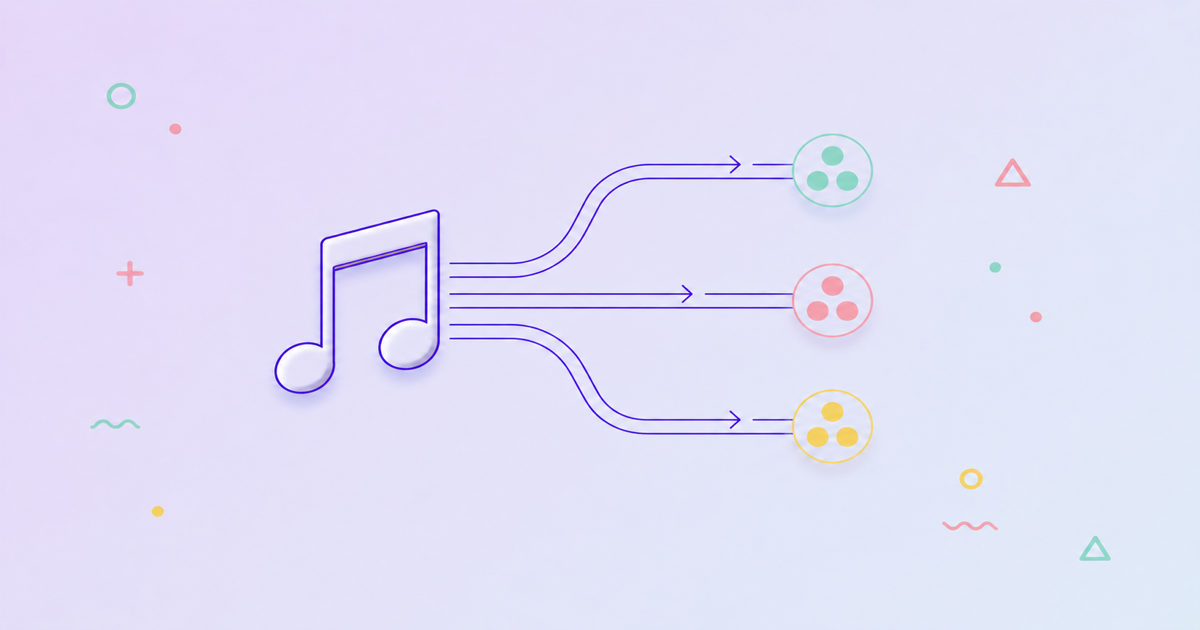
The four royalty buckets
Before AI changed anything, music royalties already lived in four separate pots. Understanding which pot pays what is the prerequisite for understanding where AI music sits.
Master recording royalties. Pay the owner of the recording. When Spotify pays a per-stream rate, this is the bucket the per-stream money flows into first. If you uploaded the track through a distributor (DistroKid, TuneCore, CD Baby, or a label), the distributor collects this and passes it on to you minus a cut.
Publishing royalties. Pay the songwriter and the publisher. These are paid by performance rights organisations (PROs) like ASCAP, BMI, SESAC, or PRS. They get triggered when the song is performed publicly: streamed, played on radio, played in a venue, used on TV.
Mechanical royalties. Pay the songwriter for the reproduction of a song. Streaming creates a small mechanical royalty automatically (in the US, collected by The Mechanical Licensing Collective). Physical copies and downloads also generate mechanicals.
Sync royalties. Pay the rights holder when the song is licensed into a film, TV show, ad, or game. Negotiated case by case. Often the biggest single payout if you can land one.
Master royalties pay the recording owner. The other three pay the songwriter or composer. AI music’s central question is: who is the songwriter when a model wrote the song.
Who can register AI music with a PRO in 2026
This is the part most creators do not realise until they try.
ASCAP updated its registration rules in 2025 to require that every registered song have at least one named human songwriter. A track generated entirely by Suno or Udio with no human composition contribution cannot be registered. If you wrote the lyrics and the model generated the music, you can register as the lyricist on the lyrical share. If you wrote the melody and the model arranged it, similar.
BMI has parallel rules. Same human-authorship requirement.
SESAC is more selective and even less AI-friendly.
PRS for Music in the UK applies similar rules and has been explicit in member guidance.
GEMA in Germany requires human authorship as a condition of registration.
The pattern is consistent. PROs around the world are gatekeeping the publishing pot to human songwriters. This is not because the PROs are anti-AI. It is because the publishing royalty system was built around the songwriter’s authorship rights, which derive from copyright, which under the US Copyright Office’s 2023 guidance requires meaningful human contribution.
What does “meaningful human contribution” mean in practice? In 2026 it generally means at least one of:
- You wrote the lyrics that the AI sang.
- You wrote the melody (humming, MIDI, or notation) that the AI arranged.
- You wrote the chord progression and structure.
- You did substantial post-generation editing that shaped the final composition.
Pure prompt-driven generation, where you typed “lo-fi track about driving home” and the AI generated everything, does not count. That track can earn master royalties when streamed. It cannot earn publishing royalties because there is no registered publisher.
For more on how to position the authorship boundary cleanly, see the workflow piece on going from idea to distribution.
Streaming royalties (Spotify, Apple, YouTube)
Streaming platforms pay master royalties on every legitimate stream. They do not currently pay you differently because the track is AI generated.
Per-stream rates in 2026 are roughly:
- Spotify: between $0.003 and $0.005 depending on subscriber market.
- Apple Music: closer to $0.008.
- YouTube Music: variable, often the highest of the three for premium-tier streams.
- Amazon Music: comparable to Spotify.
These are blended averages. Your actual rate depends on the listener’s subscription, the country, and a dozen other variables your distributor accountant cares about and you mostly do not.
Where AI does affect streaming income is on the enforcement side, not the rate side.
Anti-fraud detection. Spotify deplatforms tracks that look like artificial streaming. AI generated tracks released in big batches and streamed by a small number of accounts often trip this filter. Release on the same cadence a human would.
Synthetic music tagging. YouTube Music and Spotify have both started tagging AI generated content. As of 2026 this does not change the per-stream rate but it can change recommendation behavior. Disclosure on the upload form keeps you on the right side of the algorithm.
Catalog removals. Both platforms have removed thousands of AI generated tracks accused of impersonating real artists. The track does not need to be voice cloned. Sounding too much like a known artist is enough to trigger removal under impersonation policies.
If you want a practical guide to actually getting a track onto streaming, the piece on how to distribute AI music to Spotify and Apple walks through the upload mechanics.
The human-authorship line
The single most useful thing you can internalise is the difference between three release modes.
Mode A: pure AI release. You prompted, the model generated, you uploaded. You earn master royalties on streams. You generally cannot register publishing splits with a PRO. You probably cannot license the track for sync with major brands.
Mode B: human composition, AI production. You wrote the lyrics and the melody. The AI arranged, performed, and produced. You can register as the songwriter on a publishing split. You earn master royalties plus publishing royalties. Sync becomes more workable.
Mode C: human composition and human performance with AI assistance. Same as B but you also performed at least part of the track. Strongest position. Full authorship claim, full registration, easiest sync conversation.
The income difference between Mode A and Mode B is large over time. Mode A can earn maybe forty percent of what Mode B earns from the same number of streams, because publishing royalties roughly double the per-stream payout when you can collect them.
This is why you will hear experienced indie creators say: write the lyrics yourself, even if the AI is going to rewrite them. The reason is not romantic, it is structural. Your lyrics buy you Mode B status.
For more on the legal posture around the model itself, see is Suno copyright safe.
Sync licensing realities
Sync money is the biggest single per-track payday in music. A national TV ad sync can pay tens of thousands of dollars for a thirty second use. Indie sync (podcasts, indie games, indie film) pays less but is more accessible.
In 2026 the sync world treats AI music like this:
- Indie sync is open. Music libraries that license to podcasts, indie games, and small video productions accept AI generated tracks. Some libraries have AI-only sub-catalogs.
- Major brand sync is mostly closed. National advertisers and major TV networks ask for clear training-data provenance and indemnity that most AI music vendors do not yet provide. This will likely change once the Suno and Udio lawsuits resolve.
- Film and TV sync is in between. Some shows have used AI tracks as background bedding. Most lead-in or feature uses are still licensed from human-composed catalogs.
If you are angling for sync, two things help. First, run your release in Mode B or C so you have a clean publishing share to license. Second, document your prompts, your tool’s commercial-use licence, and any post-generation editing. Sync supervisors are paid to make conservative choices. Documentation is what unblocks them.
What to track
The paperwork is small but matters when income starts arriving.
- Distributor receipts. Which release went out which day, which platforms, which territories.
- PRO registrations. Song titles, ISWC codes, writer splits, publisher splits. Always check that the registration matches what your distributor sent out.
- The Mechanical Licensing Collective. If you are US-based and you have publishing splits, register with The MLC. Mechanical income from streaming flows through them.
- Tool plan tier and prompt logs. Your defense if anyone ever questions the rights status of a track. Keep these for at least seven years.
- Disclosure forms. Screenshots of the AI disclosure boxes you ticked on Spotify, YouTube Music, and your distributor.
A simple spreadsheet covers all of this. Do not over-engineer. The friction of opening the spreadsheet is the friction of actually keeping it.
Verdict
AI music royalties in 2026 work through the same four pots as any other music: master, publishing, mechanical, and sync. What changes is who can claim each pot. Master is open to anyone holding the recording. Publishing and mechanical require a human songwriter on the registration. Sync is open in indie tiers and mostly closed in major brand tiers.
The takeaway for indie creators is to build your workflow around Mode B or C. Write the lyrics. Sketch the melody. Let the AI handle the technical craft and the production. You will register cleanly with your PRO, you will earn the full royalty stack, and you will have a sync-friendly release.
This was not legal advice. Talk to a music attorney and your PRO before relying on any of this for a real release. And if you want a music platform where the rights story is handled at the tool level so you can focus on the song, Melodex is built for exactly that.
Frequently asked questions
- Do I get royalties for a fully AI generated song?
- You usually get the master recording royalties paid by your distributor, because you are the rights holder of the recording. You generally do not get publishing royalties through ASCAP or BMI on a track with no human authorship contribution.
- Can I register an AI track with a PRO like ASCAP, BMI, or PRS?
- ASCAP and BMI in 2026 require a human songwriter on the registration. PRS in the UK has similar rules. If you contributed real authorship to lyrics or composition, you can register. If the song is fully model generated, you cannot.
- Does Spotify pay differently for AI music?
- Not by formula. Spotify pays per stream regardless of how the track was made. What it does is enforce policies against artificial streaming and against tracks that infringe other artists. Detection is improving year over year.
- What about mechanical royalties from a cover of an AI song?
- If a human covers your AI song, the mechanical royalty flow needs a registered publisher. If your AI song has no registered publishing splits, the mechanical money has nowhere to go. Register your splits before anyone covers you.
- Can sync licensing work with AI music?
- Yes for indie sync. Major brands and TV networks are still cautious in 2026 because of unresolved training-data lawsuits. Document your prompts and your tool's commercial-use licence to make any sync deal go faster.
- Do I need to disclose AI involvement to streaming platforms?
- Spotify and YouTube Music have started asking. Apple Music has not made it mandatory. Tell the truth on the form. The penalty for being caught hiding AI involvement is removal from the platform.
- Is this legal advice or financial advice?
- Neither. This is general information for indie creators. Talk to a music attorney or a registered PRO before relying on it for a release.
Keep reading

How to Export Suno Stems to Ableton, Logic, FL Studio
Walkthrough for exporting up to 12 WAV stems and MIDI from Suno Studio into your DAW, with project setup and routing.
How to Make AI Music Sound Less Robotic
Ten techniques to humanize AI-generated music. Variations, layering, DAW tricks, and prompt patterns that pull the AI sheen off your track.